Space Blankets and Spurs
Houston boasts its excellence and holds claim to a great many things. From its spectacular Bar-B-Q, its wide open spaces ( God’s Country ), the largest rodeo this side of the Mississip ( or Northern Hemisphere for that matter ), and even somehow the biggest sky. As the Texans sing proudly in the streets, “The sky at night is big and bright…clap,clap,clap,clap, deep in the heart of Texas”! I mean even when I was a kid growing up in the Midwest I could stay up late if I watched the show Dallas with my mother. The beloved 80’s soap opera style drama about the Ewing family and its oil empire. After all, the highly fought over commodity is called “Texas Tea”.
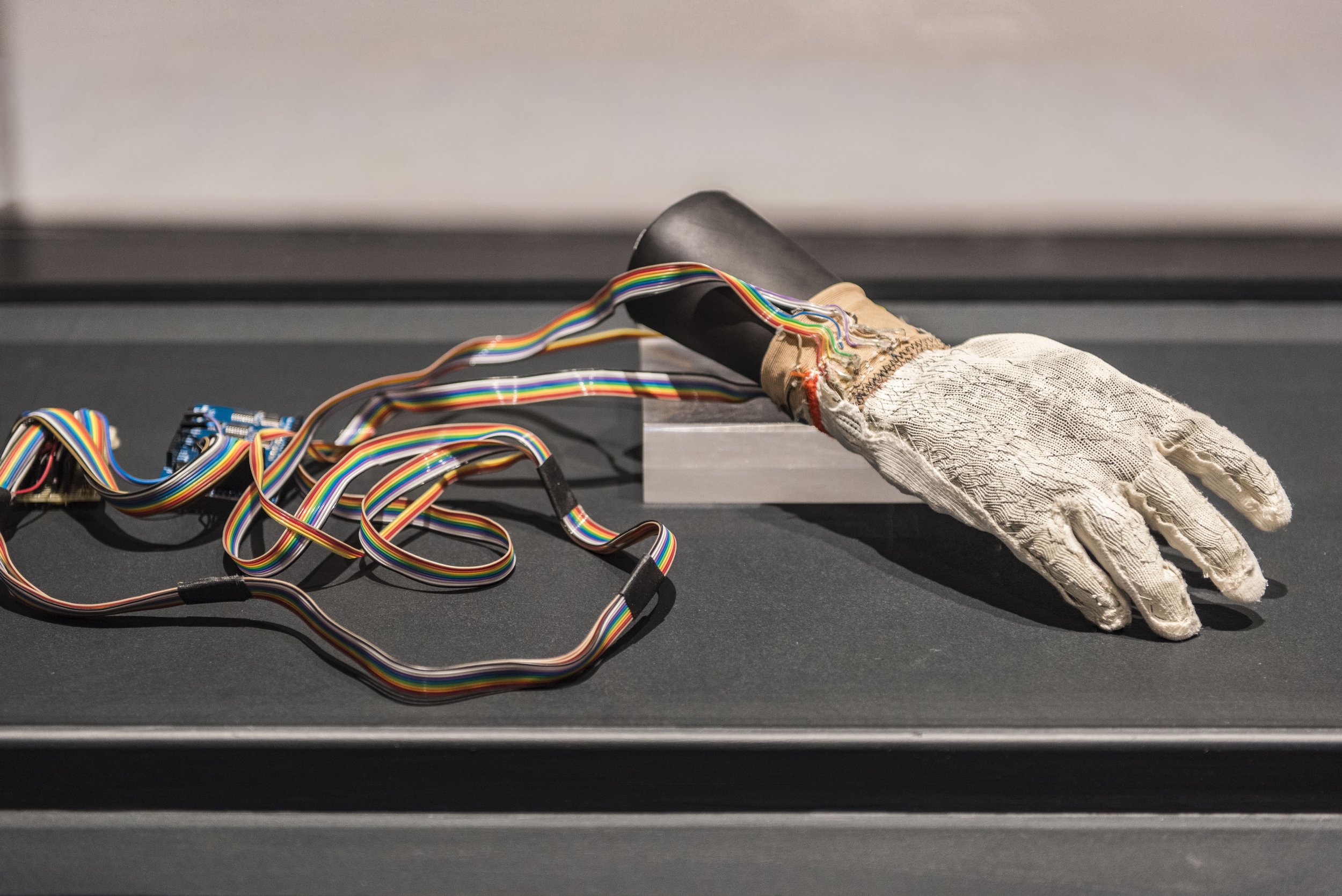
Photo: Graham Bell
Courtesy of The Houston Center For Contemporary Craft
We are a big state with even bigger egos. According to Texas just about everything has a Texan origin story. However, the one thing we seem to glaze over is the deep history of craft and how it has formed almost every aspect of our southern lineage. From elaborate cowboy boots, giant custom belt buckles, to high dollar hand steamed hats, and that is just the honky tonk side of the crafting. There is an exponential list of trade skills and making that we see everyday but doesn’t always translate to the “Texas Made” national recognition. These would be practices that originated in Mexico and with indigenous people but built our heritage and image like Taravera Pottery, the Cuera ( the suede jacket style we recognize in modern western culture ), the widely know Surapa, palm woven hats, and the other hundred styles and variety we have adopted and cherished over lifetimes. Today we instinctively associate jewelry, low riders and slabs, and lavish western wear to be Houston. This is what Sarah Darro, Curator & Exhibitions Director at The Houston Center of Contemporary Craft, had in mind when she began to dive deep into the research for her recent exhibition and project Clutch City Craft.
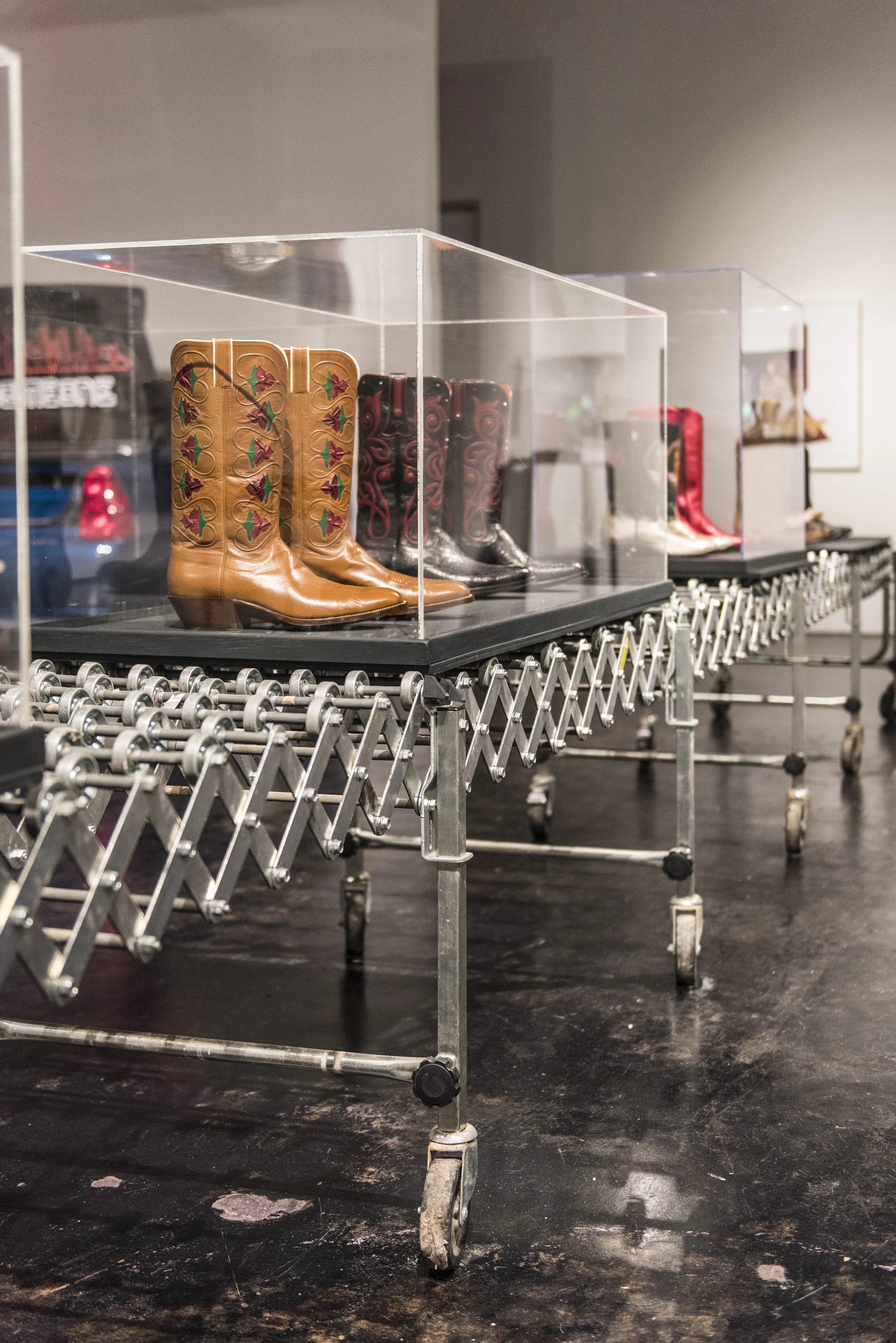
Photo: Graham Bell
Courtesy of The Houston Center For Contemporary Craft
Clutch City Craft is presented in concert with Handwork: Celebrating American Craft 2026, a national semiquincentennial initiative organized by Craft in America and the Renwick Gallery of the Smithsonian American Art Museum. The scope was to showcase the central role of handmade knowledge in shaping American life, and Darro took the idea and ran with it. What Makes Houston in the eyes of Texas. In the eyes of the country? You can’t throw a bolo tie without hitting a trade or skill so deeply embedded in Texas culture. So why aren’t we talking more about the crafts that built this city or our communities? The reason is that it is so expansive and all encompassing we completely fail to see their beginnings. “The more I dug into what I was seeking after the more I realized that The Best and The First often came from here. I really had to reign myself in with this project while I was researching. This show could have been massive”, Darro stated excitedly over coffee. “In Houston, there is something a lot of people are not getting when they come to the Craft Center. They are not always noticing that there is highly skilled craftsmanship around this city that they aren't tuning their eyes to. You have to retrain your eyes. I had a brief foray in archeology so I'm always looking down and to the ground more than other people. So if you notice that those are incredible mosaics and they are all hand tiles that is pretty bonkers. Those were our first wayfinding signage”. Darro motions to our feet and past scene we cannot see now, making reference to The Blue Tile Project people she saw in the past restoring hand crafted mosaics embedded into the curbs and at street level near HCCC.
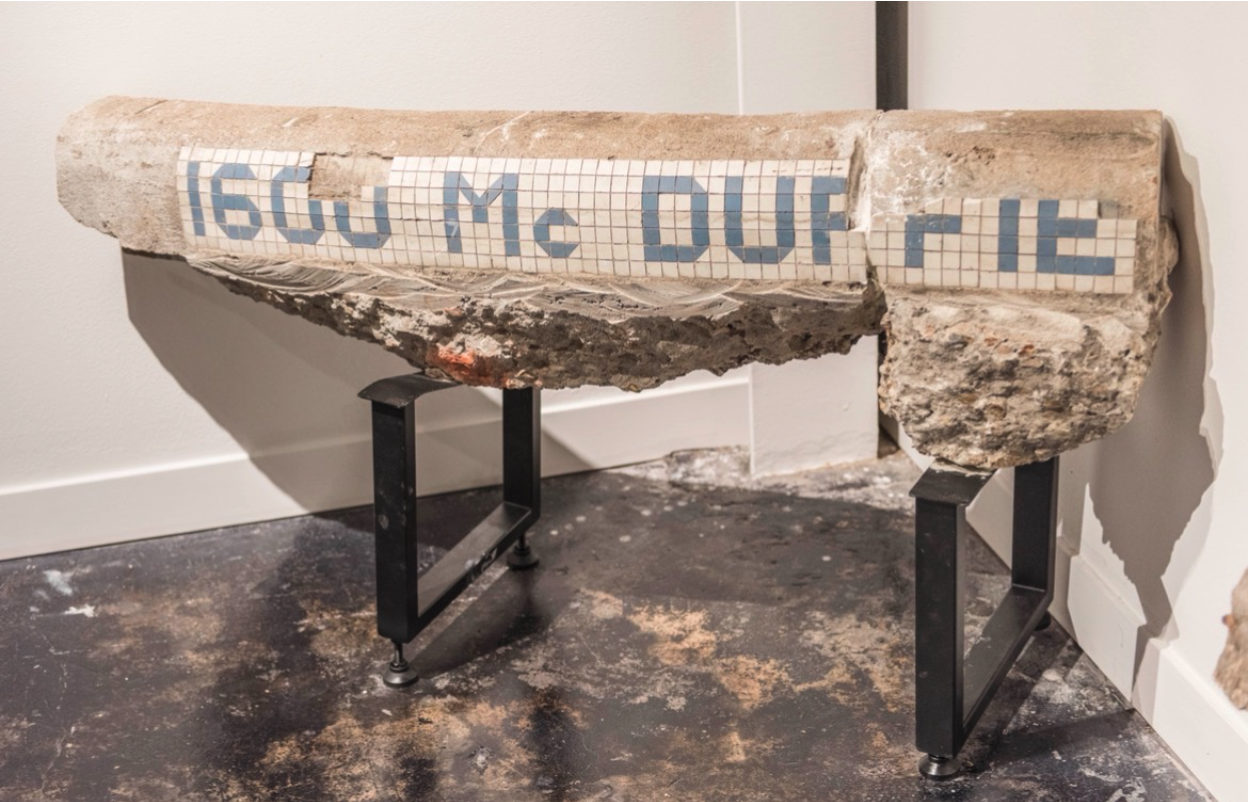
Historic Houston blue and white tile navigational street signs
Early 20th century–mid-20th century
Photo: Graham Bell
Courtesy of The Houston Center For Contemporary Craft
The Blue Tile project, a non profit initiative that creates through tedious restoration and historically remaking. The group works with some of the last surviving examples and reinstalls those lost, “returning skilled craft to the city’s literal groundwork”. Starting in the 1920’s the original tile work was a city driven strategy to stop the theft of Houston’s hand painted street signs by creating the unique wayfinders out of tile. Today The Blue Tile Project continues to stay true to the hundred year old recipe and technique to recreate and repair the small yet massive part of the city's history. Along with The Blue Tile’s examples of broken curb and beautiful tile work, within Clutch City Craft you can find other historical examples of the literal foundation of the city such as Alexander Squier’s The Houston Brick Archive.
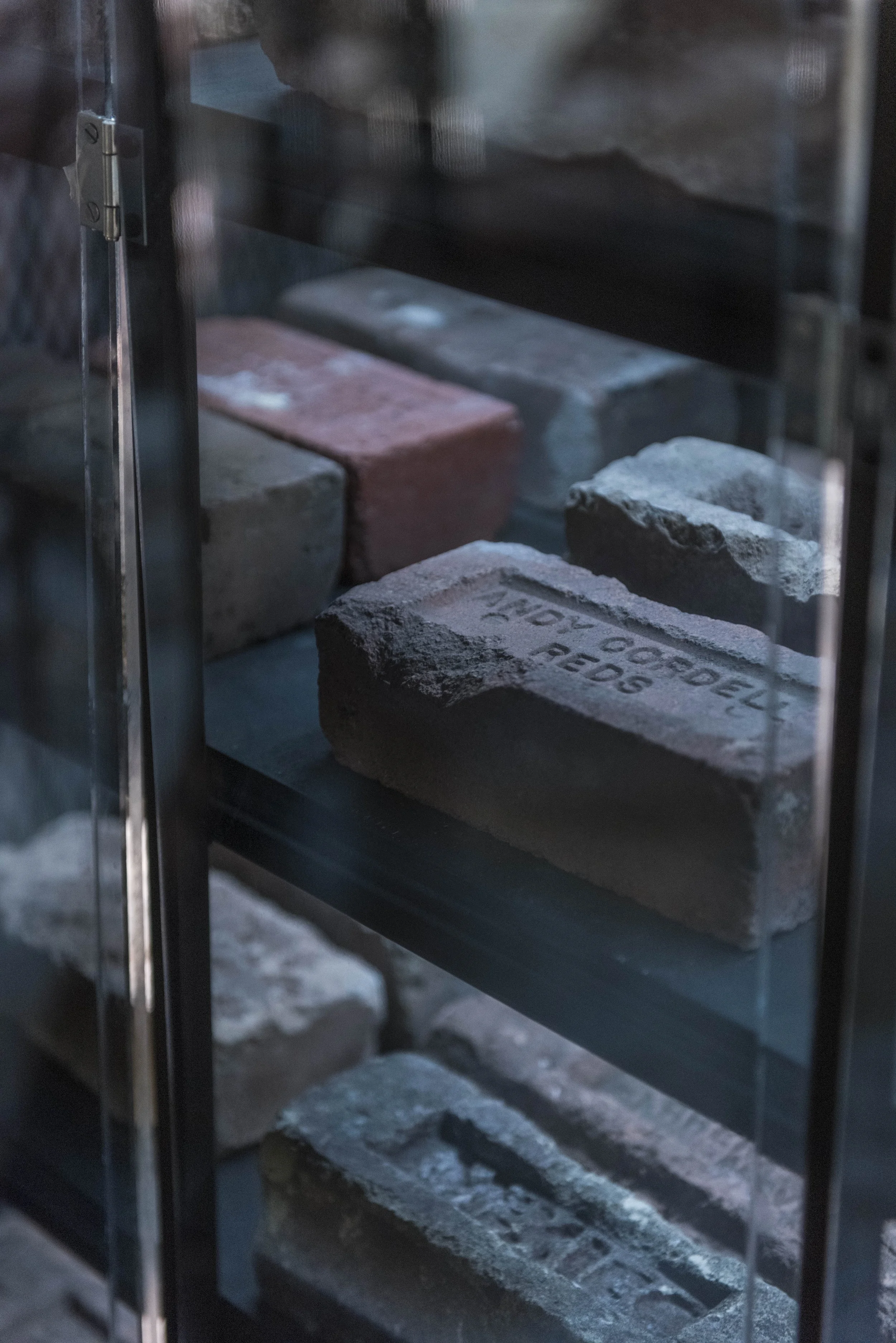
ALEXANDER SQUIER (Houston, TX)
The Houston Brick Archive, 2016-present
Salvaged bricks, casework, video
Photo: Graham Bell
Courtesy of The Houston Center For Contemporary Craft
Squier’s installation and archival pursuit brings forth the wild history of Houston’s brickmaking and its fundamental importance not just for our roadways, but its source of the rich clay directly under our feet. The industrial boom caused a surge in local production and later expanded to other parts of Texas, the US, and Mexico transforming durable earth into roadways in the past and our buildings we still have today. Many of these brick roadways can still be found proudly in Houston’s Fourth Ward, where one of the main African American brickmaking facilities was established.
Anna Mayer is another exceptional conceptual craft driven artist featured in the show and who had a solo show at HCCC, Forms of Inheritance opening during the pandemic in January 2021. Mayer’s ceramic forms were forged from Houston’s industrial and extraction sites, creating beautiful and pure objects from the material and clay and resembling the very drill tips used for directional drilling. “The material is actually brought to the surface from drilling practices, natural disasters, and construction. That’s so Fucking Houston”, Darro states with uncontrolled glee. The works are then fired in Mayers DIY Rocket kilns made of chicken wire and ceramic thermal wool with a propane tank creating the fuel to the furnace. While it looks insane and terribly unsafe there is beauty in the chaos. “It has this rogue and gorilla ceramic thing happening within its process and it creates a nice segue between infrastructure and aerospace”, Darro says, making reference to its crude design but with the thermal insulating wool which plays a key role in Nasa’s construction on its space shuttles and other launchables.
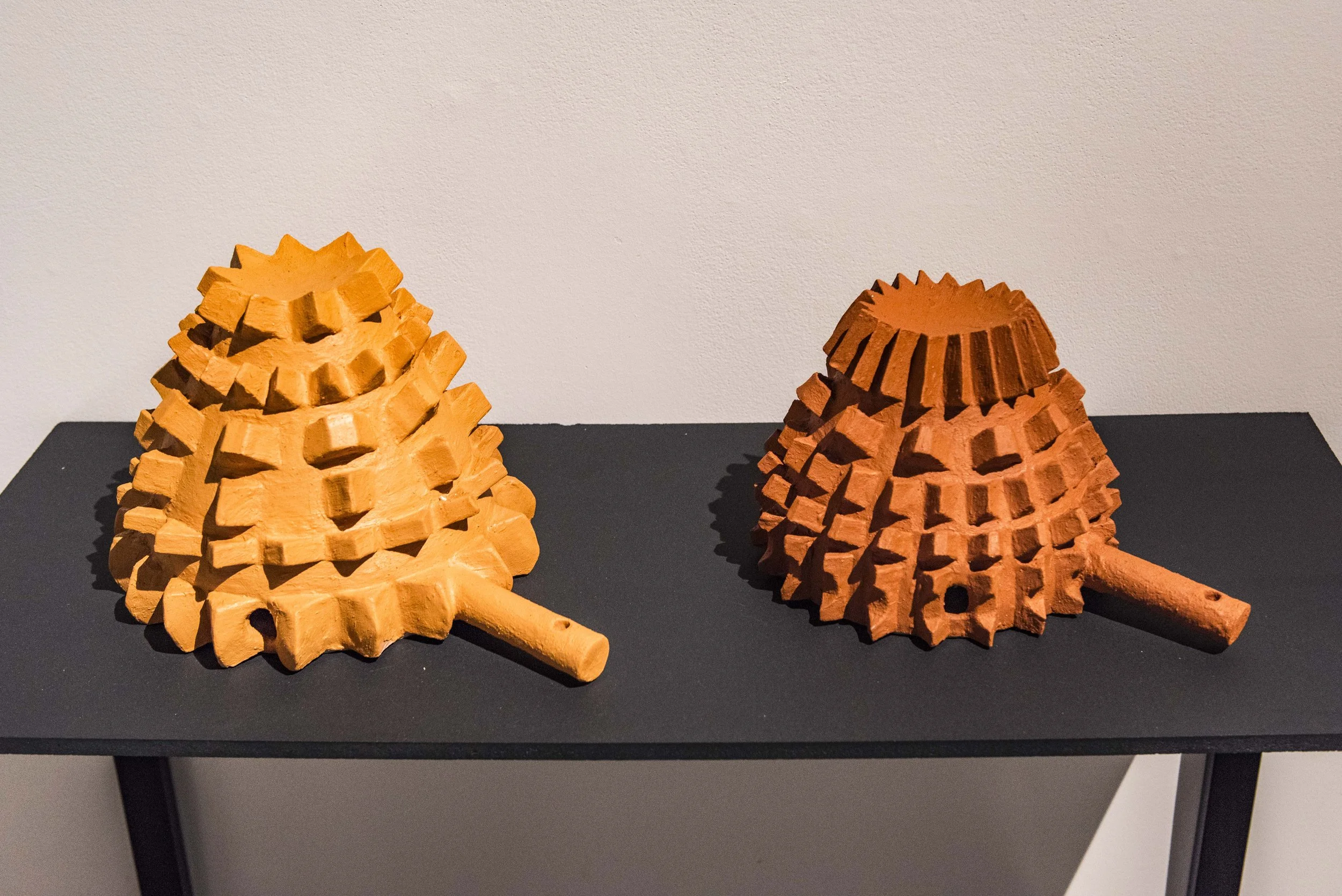
ANNA MAYER
(Houston, TX)
Earth Faced Hughes Cones, Nos. 1-3, 2026
Ceramic clad in gleaned clay from Houston, sealant
Photo: Graham Bell
Courtesy of The Houston Center For Contemporary Craft
The exhibition is laid out in a mimicked factory-like setting. While there are nods to timelines, history, and segmentation based on industry, its curation is unique and flows organically. There is tranquility created from the harshness and pollutants from petroleum, silica, fiberglass, and byproduct. Factory conveyor belts are stretched out across the main gallery floor, which also act as additional supports for plexi vitrines, pedestals, and intricate craft objects. I know that from behind the scenes conversations and comments made at the opening night introductions, that the idea was there to have working conveyor belts moving works around the space and even to have the gallery’s floor covered in 3 inches of sand. The fever dream curation vibes that work great in theory but overall don’t always translate with the overall delivery.
The exhibition continues to celebrate Texascentric trades and skills are handcrafted cowboy boots by legendary Rocky Carroll, Graham Ebner, and the Republic Boot Company, with clay and sculpted boots by NAPOLEÓN AGUILERA, of Guadalajara, Mexico. Broken Obelisk Elbows by Phillip Pyle II is a clever tip of the cowboy hat to Barnett Newman’s Broken Obelisk and slab culture and of course diamond studded Grillz by Prince and Paul Wall’s Framed Platinum Album. A slab car back end featuring a not so practical neon in the trunk paired with the functional and interstellar craftsmanship of the many NASA artifacts, helmets, gloves, components, and thermal insulation blankets and samples.
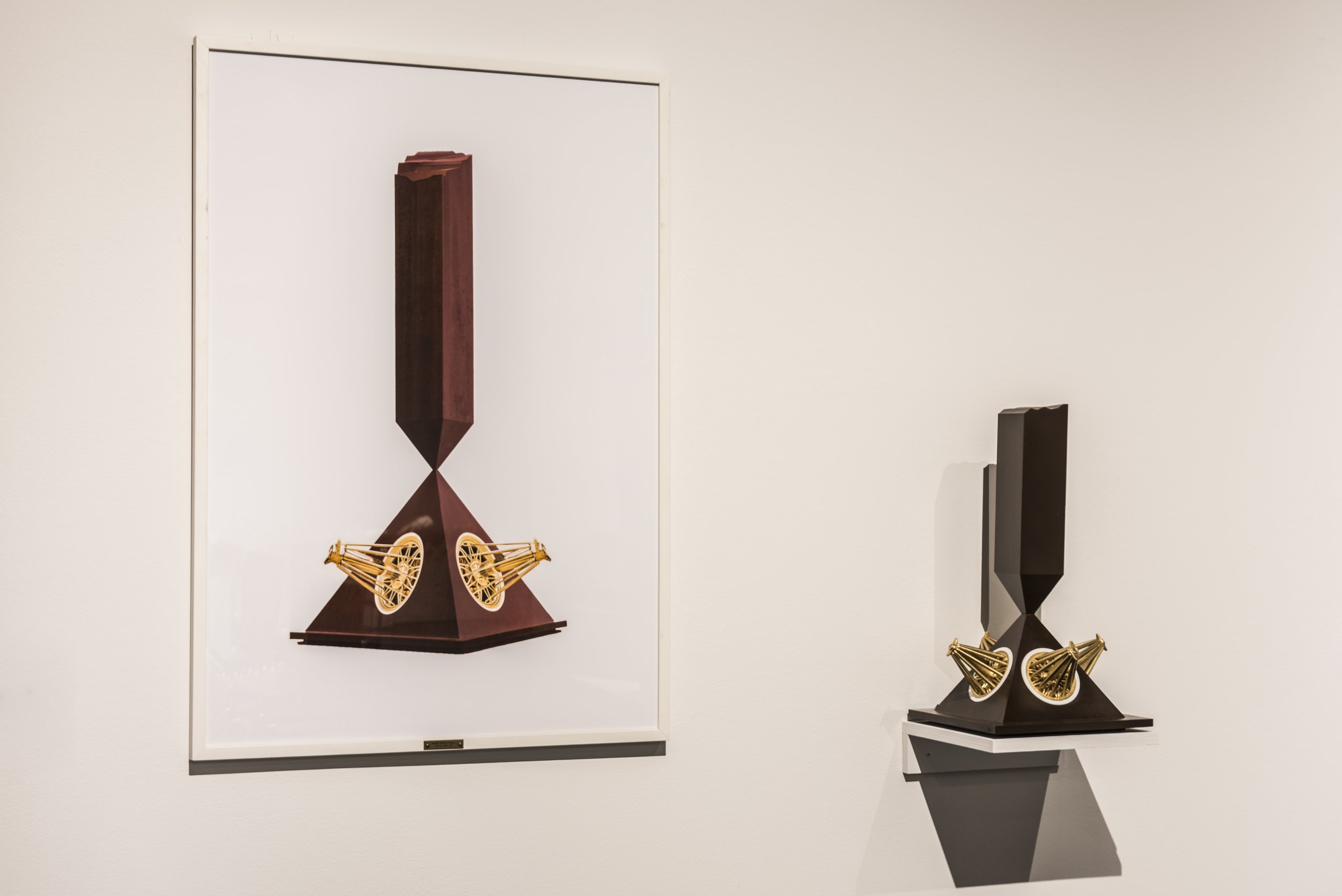
Phillip Pyle II,
( Houston, TX )
Broken Obelisk Elbows, 2026
3D Print, Paint
Photo: Graham Bell
Courtesy of The Houston Center For Contemporary Craft
The most fascinating aspect of the exhibition truly comes from the connection and education Darro provides guiding the viewer through the craft and the creative making process that develops over the years within NASA and Aerospace developments. As one might make the assumption that these leaps and bounds are merely the product of labor and industrialism, you would be proven incorrect. Reading through the materials presented and watching the few accompanying short films, it's mind boggling how much of the textile and fiber world is involved with some of NASA’s major breakthroughs. I had the pleasure to get some more insight with a walk through with Darro as she explained the incredible processes, woven examples, and depth of production through the hands of craft artists. “Even the seatbelts, harnesses, and upholstery work were created by many of these artists' practices and techniques”, she exclaims.
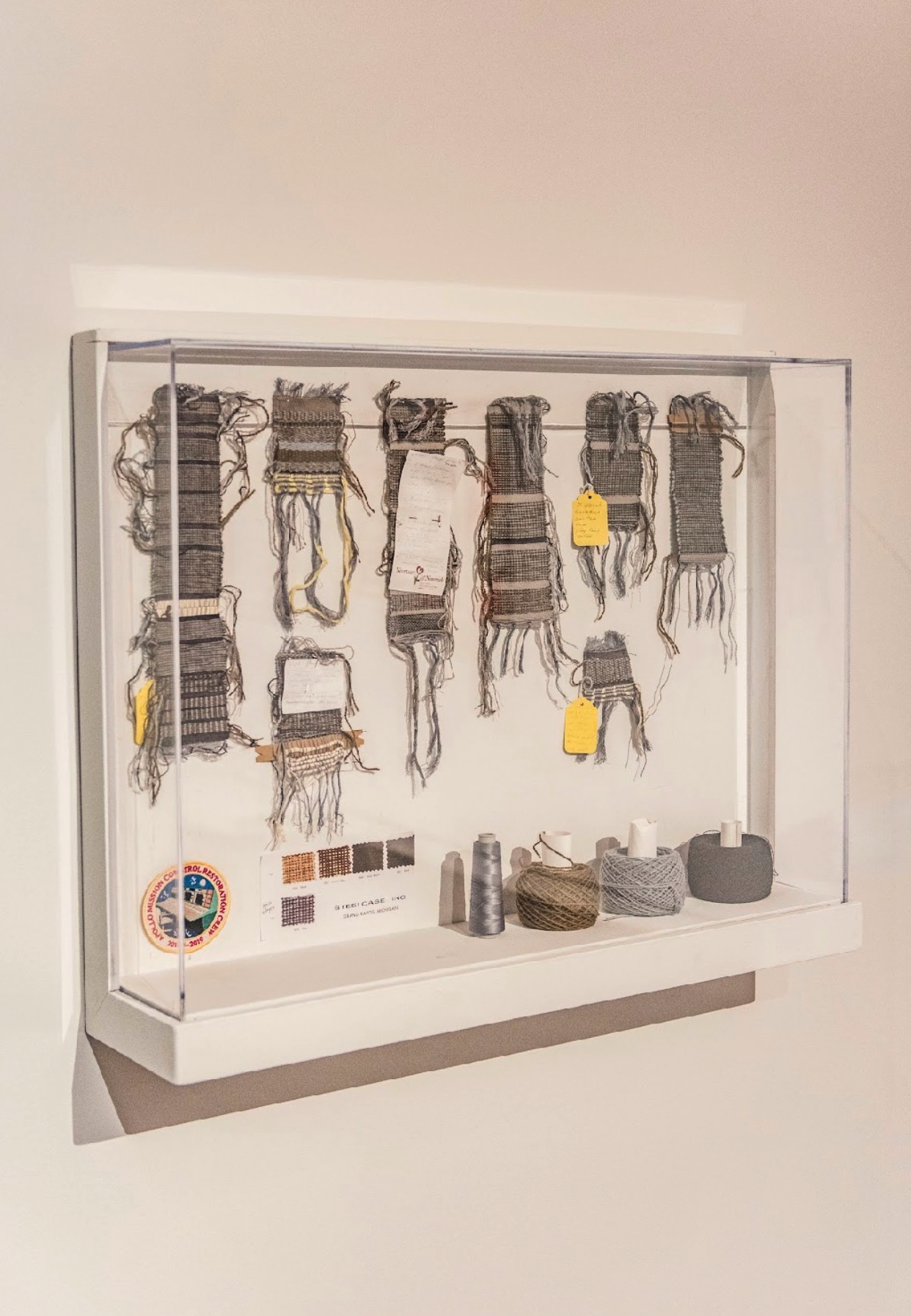
Mary Welch, Weaving drafts and samples commissioned by NASA for the upholstery fabric for the 2019 preservation of Mission Control.
Photo: Graham Bell
Courtesy of The Houston Center For Contemporary Craft
Of the most compelling works in the show and artwork supporting the artifacts of the “Space Race” was the piece by Shannon Swinburn. Give me Guidance 1, honors the widely unrecognized works and craftswomen who meticulously created the Apollo Guidance Computer’s Core Rope Computer Memory Modules. Through intense hand weaving these incredibly skilled women were recruited for their textile and fiberwork knowledge. Tediously they threaded and laced wires through magnetic cores to encode software that made possible the navigation of the Apollo module into space and to the moon. The contemporary weaving of Swinburn's piece reimagines the history and contributions of these past craftswomen as the work is suspended in a loom similar to the original NASA Fabrication frames.
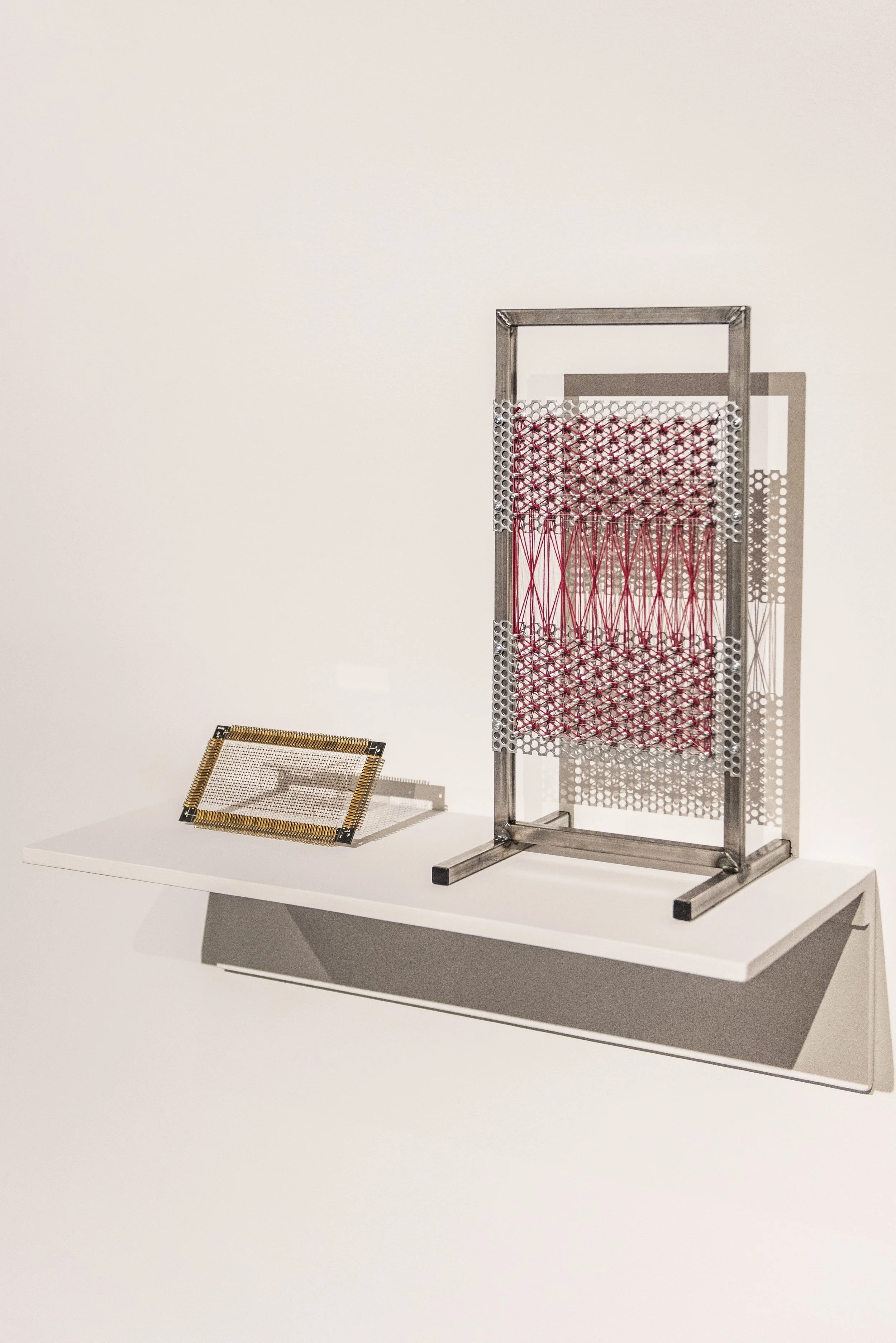
SHANNON SWINBURN (London, UK)
Give Me Guidance 1, 2023
Steel, cotton, wool
Photo: Graham Bell
Courtesy of The Houston Center For Contemporary Craft
I could literally write on for a hundred more pages about the finely tuned nuances of this exhibition. You could tumble down the rabbit hole with me and the fascinating aspects of the over two decade long history of the shuttle tile process melding science, newly discovered technologies, and the traditions of ceramic tile making. Alas you will just have to join this mind bending journey yourself within this exhibition.
Screwston, H-town, The 713, Space City, or Clutch City we know Houston by many names. More times than not, we forget what built this city, or rather who built this city that we adore. Making assumptions of how our history came to be when the whole time it all started with indigenous hand weaving or the forming of our own natural clay to create the paths to our neighborhoods. Darro did her homework and then some. It truly shows the passion that she harnesses with HCCC, her meticulous research, and drive to educate us on the new forms of viewing. It's an exhibition you can visit again and again and investigate a new element each time. Her eagerness to show the viewer and the world that Houston, Texas, and all of our southern neighbors have much to be excited about. After all it was Craft that took us to space, the moon, to Mars and who knows where else!
Handwork in Orbit: A Conversation on Craft and Aerospace Innovation
Date & Time
Saturday, May 23, 2026 3:00 pm
to 4:00 pm
Venue
Houston Center for Contemporary Craft
Address
4848 Main Street, Houston, Texas 77002