The realm of technology seemed so promising when I was younger. The internet and ever-improving processors laid forth a motherboard-paved road of possibilities. Marty McFly’s hoverboard was our beacon of light showing us what technological innovation was supposed to be. We had everything and so much more on the way.
With creatives, new visions, and industrial science comes the desire to understand it and harness it as a fresh medium. Starting in the 1960s, artists began pioneering the uncharted territory. In 1966, Billy Kluver – a technician at Bell Laboratories – and Robert Rauchenberg brought together 10 artists and 30 engineers as a part of a New York art project called 9 Evenings: Theatre and Engineering. Kluver believed there was much to gain from the collaborations of engineers, technology specialists, and artists, and that through their overlapping explorations, new pathways could be created. Passages through which all parties could build upon. The project was a huge success and is considered by many scholars to be a monumental shift in media-based art.
Following the project's conclusion, Kluver formulated Experiments in Art and Technology (E.A.T.) with the intention to continue the dialogue between artists and engineers. The group grew to over 5,000 members and included such notables as Andy Warhol and Jasper Johns. As the years ticked by, so did the mounting output of computer-based works. Some exceptional, some so-so, and just as many unsuccessful. If there was a question of how to use it, creatives would surely seize the opportunity, from dance and film, to technology used as a physical medium. In 1992, Albert Oehlen began his “bionic” or “data overload” series of computer paintings highlighting low resolution and pixelation. In the same vein, David Hockney painted with an iPad during the Covid pandemic years, using elementary computer-based paint styles to conjure gorgeous hybrids of simplistic yet refined drawings and paintings.
While the great successes of artists using new media to present brilliant outcomes is known, what of the directions we take to present information within exhibitions now? What supporting devices have we truly tamed to bring to the surface a new and refreshing way to build upon the viewing experience? The traditional entryway is a large wall filled with text. The threshold which gives us the information of who the artist is, the objective of the exhibition, the title, and maybe who has supported it within the context of said presenting institution. Maybe there is a TV mounted to the wall, a projection, or if we get fancy, perhaps a touch screen to give us the illusion of more control as a viewer. Most of the time it gives us a bit more eye candy to better bring the concepts and visuals together. I, myself, would be one of the art nerds that enjoys spending the time to read the name plates, didactics, and flipping through additional materials neatly placed in the clear plastic holder mounted to the wall.
We all have our own takeaways to discover through an exhibition or the series artists they grant us with, however it's always a bonus when we feel a true resonance with the message. The “oh, shit” moment when we get close to seeing through the artist’s eyes. Overall, we have to rely on the collaborations that form between the curator, artist, and facility guidance. Not just what pieces are selected, but how they are ushered to the viewer. A sculptor can still have a black box showing films about the work’s creation. The space throughout the exhibition can be radically changed for the painter to better represent a region, their studio, or evoke emotions with tight spaces or dim lighting. Even the decisions to turn a white room to a neon pink gallery can make a complementary statement. So how do we incorporate new technologies in building upon these interventions? What is going to properly elevate versus what becomes another random method of delivering information?
I know that I can be a purist at times. An art curmudgeon, if you will. That mostly stems from my undergraduate years of being mentally beaten down by my even more beaten-down professors at SAIC. It was a challenging journey as a young painter, but most of the time they weren’t wrong. In their eyes and now mine, it all boils down to the question, “does this make the work stronger?” We tend to rely on technology as a sugar-coating rather than a vessel. When QR codes hit the streets in the early 2000’s, it was a widely exciting development. An entire flyer, poster, business card, or even video appears instantly with just a click of your phone’s camera. The potential was there and creatives across the map were implementing the new codes. Suddenly black and white squares were taking the place of screen-printed handbills and posters. The process was cool, but seemed to stall out as people are visually-driven by nature. Food pellets can deliver all the sustenance that one might need, but I would much rather enjoy a grilled buttery steak or homemade raviolis.
Fast forward 20 years and QR codes are everywhere like an obnoxious rash. It’s assumed that every individual has a cell phone glued to their palms and all children are staggering through museum hallways with iPads in their faces. This of course does not even scratch the surface of the financial availability of said devices for young viewers or school groups. I recently had a conversation with a head curator of a major institution and I brought up the fact that they had an immersive artist return after only two years. “The young people like taking pictures with it,” they shrugged. “We’re in an age of Instagramable content and instant gratification.” While it made sense for getting people in the door, it was certainly a sad statement to hear. Can we adapt without compromise? Today we have augmented reality, bringing classic artists back from the grave to stand before us explaining the works or VR headsets to witness sculptures in a realistic environment that we can navigate from the inside out. Nothing beats the real thing in real time, but these interventions can be engaging and exciting if done well. In Houston, we have entire spaces devoted to hot, fast, instant visuals. Spaces like ARTECHOUSE and Art Club are presenting pieces that are to be experienced from within and to engulf the senses. Do we always need to be engulfed by an exhibition? Not always, but these spaces and artists are paving the way for innovative methods of presentation for a new generation.
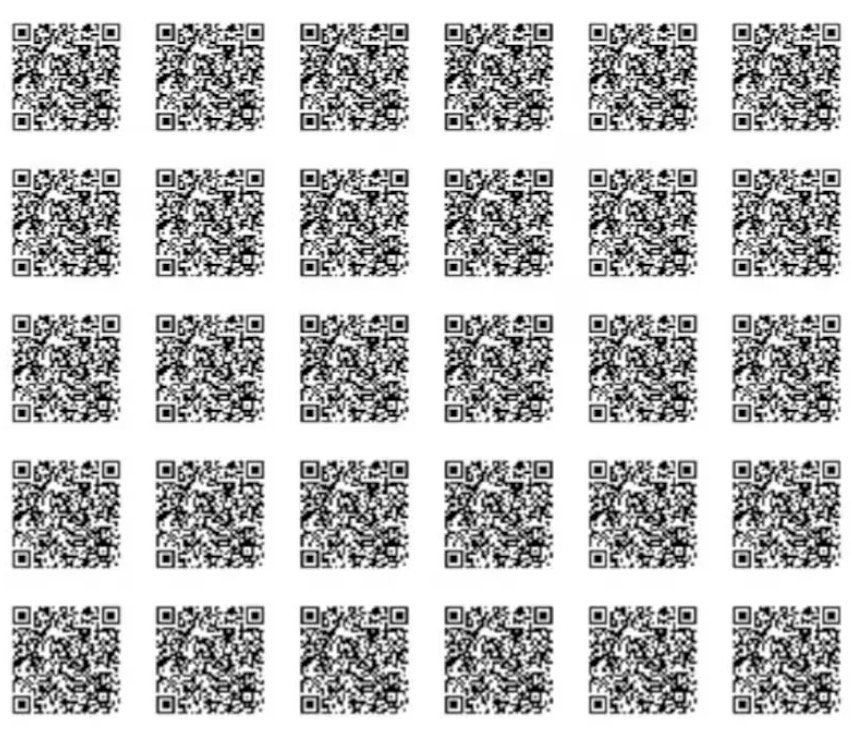
I love the tactile. I believe most of us still like the smell of oil paint when stepping into a studio or the memories invoked when strolling through a musky old bookstore. Sometimes it's nice to create our own emotions with a work of art, but at the same time, have the proper supporting information to take or leave as we feel fit. The other day, I bolted out of the house to an exhibition, jazzed to see the work of a new artist. During the rush out the door, I realized enroute that I had forgotten my phone. Not a problem, I don’t need to take constant photos to enjoy and experience and, to be honest, it's important to disconnect once in a while. So far so good, I made it to my destination, found parking in a timely manner, and stepped into the space. Lots of work presented through various mediums. It was a small independent gallery, so it’s not as I expected a title wall or short essay printed in vinyl. Walking over to a small desk to look for a price list, I was greeted by a large 8.5” x 11” QR code. Blargh. So without wall labels, a statement, or price list to provide me with materials, titles, and such, I was left with frustration. Without my phone handy, I had only a useless QR code. I could talk to the artist, and I did, but I'm not going to go piece by piece to get a private tour of the works. Not to mention this wouldn’t be possible if the gallery was packed, as it was shortly after I arrived. Now I am left with just a gut reaction to each piece. While this is clearly an important part of the viewing experience, I did ask myself, where is the information? What's the drive, message, or story? After I spent a fair amount of time with the pieces, I left with an extemporary feeling without knowing further about the works.
It’s not infrequent that we use technology to cut corners. Laziness isn't necessarily the culprit – I don’t feel that was the motivation for this particular gallery – but it doesn’t take much time to print an artist statement and pricing list. On the overall assessment, I do very much feel that institutions have failed to use new media or technology in creating a better viewing experience. I don’t want your pricing sheet downloaded on my phone or filling my cloud, but I would appreciate having it to better understand the overall conversation of the work. It complicates a process that should be rather straightforward. Want to make it even more frustrating and silly? Print PVC or foam-backed labels but they are just QR code placards. I've actually seen this! Here you are, spending the same amount of time it would take to create a physical label for the work, just to create a more difficult experience.
Locally, Moody Center for the Arts operates as both a creative incubator and a museum. Successfully bridging the gap between art and technology, the curators and exhibition designers work to not only find the artists that fit well with the process, but to work with and co-create with less familiar artists. Not all artists want the bells and whistles of supporting media and many projects don’t need it. However, an advantageous intervention can speak volumes. Many international artists like Olaf Eliasson work more as scientists or pioneers than as studio artists. With his compound and warehouse hosting droves of chefs, botanists, chemists, environmentalists, and other artists to better understand not just the new works being manifested, but to understand the environment in which they are viewed.
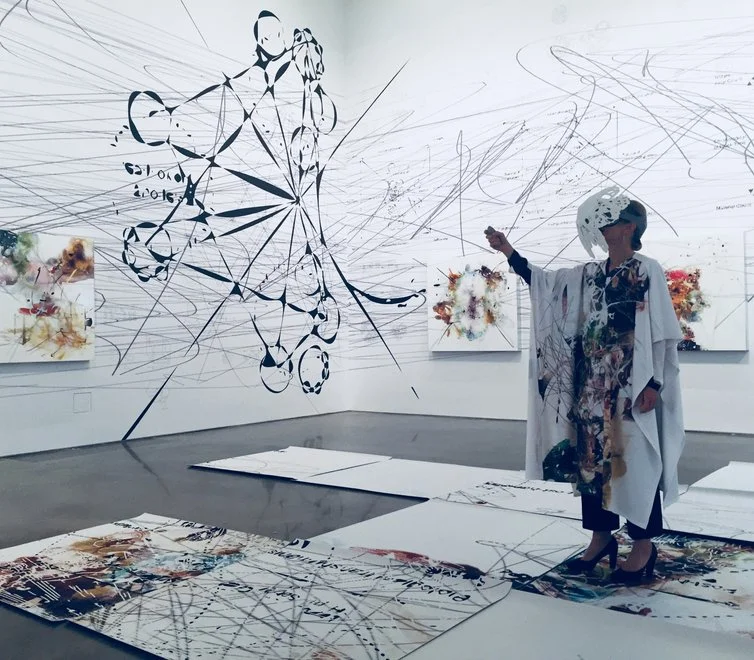
Matthew Ritchie at Rice University’s Moody Center for the Arts, 2018. Photo: Paul Middendorf
In 2018, Matthew Ritchie was the second Leslie and Brad Butcher Artist-in-Residence at Moody following Olaf Eliasson’s own exhibition and project in 2017. Working at an institution with a sizable budget certainly helps the collaboration, but understanding which ideas will work and which ones will fall short is key. I knew of Ritchie’s earlier works, consisting largely of paintings, installations, and sculptures. His pieces originate from the nooks and crannies of science, sociology, and anthropology. With the exhibition at Moody and through the residency was a brand new body of work exceptionally built on top of a new technology and research heavy foundation. You can read about the works and the ideology of the process from an interview I did with him here if so inclined. With so much knowledge injected into the exhibition, it would seem impossible on how to present everything all at once, to keep the body of work clean and engaging yet still accessible. In one of the large secondary galleries, visitors were presented with a half-dozen cult-like, masked figures wandering around the installation, which was covered in Ritchie’s mark making, imagery, and special hand sketched coding upon the floors and walls. First walking through the door, visitors were instructed to change into a robe and place a tribal-style helmet, concealing the VR equipment, upon our heads. Once placed upon your head, you were now part of the installation yourself. You became one of the wandering cult figures, working your way through the space, reaching through the air to tap and open floating symbols inside the ether of which you were one with. Each symbol, once opened, presented you with videos, lectures, and a vast amount of readable material.
The symbols were everywhere and while I only spent forty minutes or so inside the environment, I was told by Ritchie that I could easily spend a full day inside absorbing the data he had created for the viewer. It may have been one the most captivating methods of not just telling a story but providing a cache of knowledge that the viewer was offered to take or leave. The gallery viewed from the outside looked like a choreographed performance thriving inside his installation. Inside was your own monumental library from the past, present, and future. New media can add to an exhibition or it can subtract, but its base line is to elevate. With developments like AI, we see how damning it can be to find quick and easy solutions. It's nice to have a cute robot that scoots around your living room picking up dust bunnies and balls of cat hair, and yes, it saves us a little bit of time. Alas, we aren’t relying on a vacuum cleaner to activate our subconscious either. We desire to know who the artist is that made the work we find so exhilarating and want to know as much about it as the artist wants us to know. We strive for a moving experience when visiting an exhibition, something to learn and even grow from. We haven’t even begun to reach the potential of our technologies that are currently out there and there are more and more being created each year. There is too much chaos, static, and noise in the world and the day-to-day, which is why it's paramount to find resonance and tranquility where we can. Sometimes less is more. Perhaps we should leave the QR codes at the door. Sometimes they might even be the right choice for a given situation, but if we needed quick and easy curators, we could just hire Roombas to do the work. We don’t always have to out-do what’s come before, but a more thoughtful approach is best when considering the viewer-artist relationship.